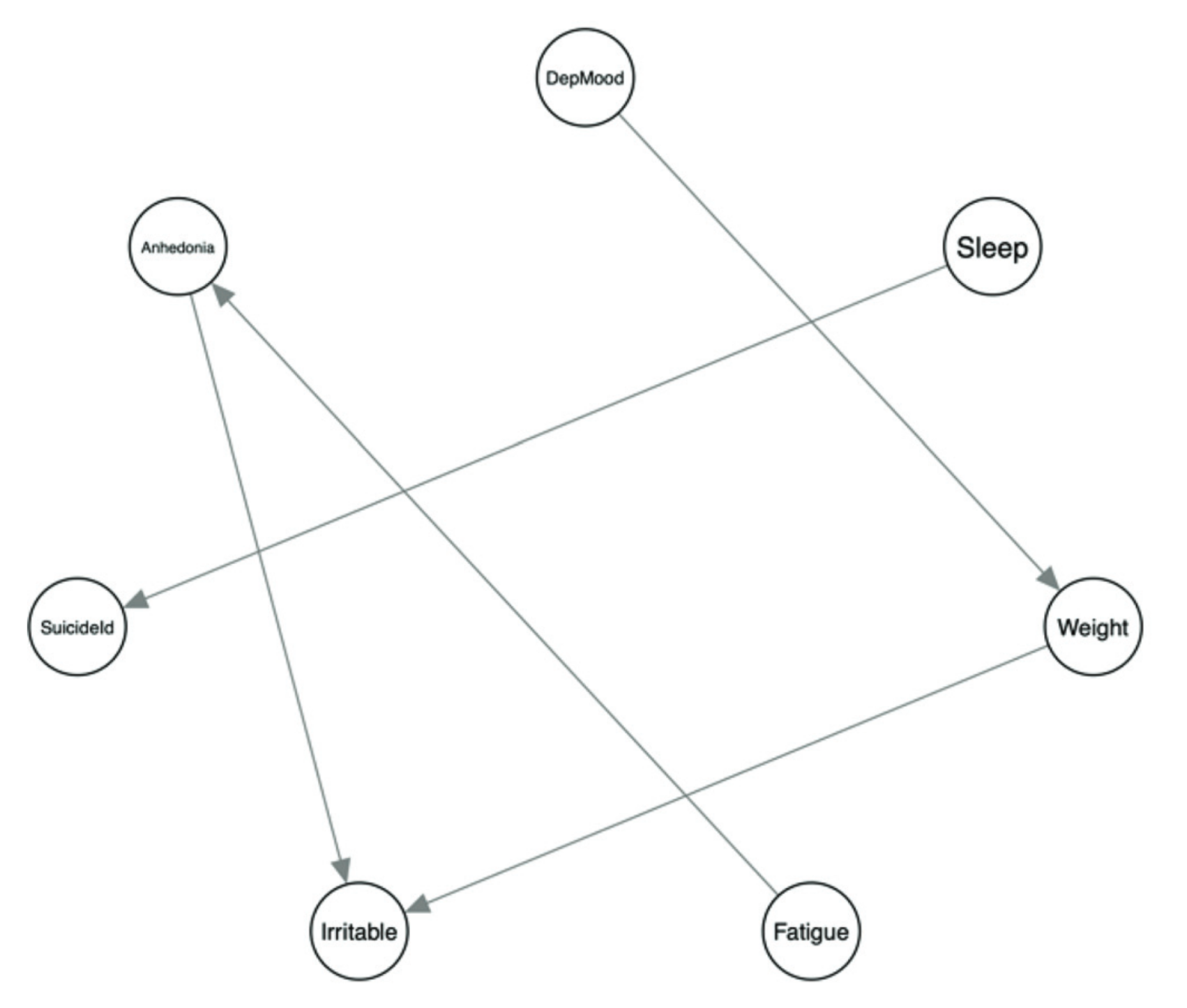
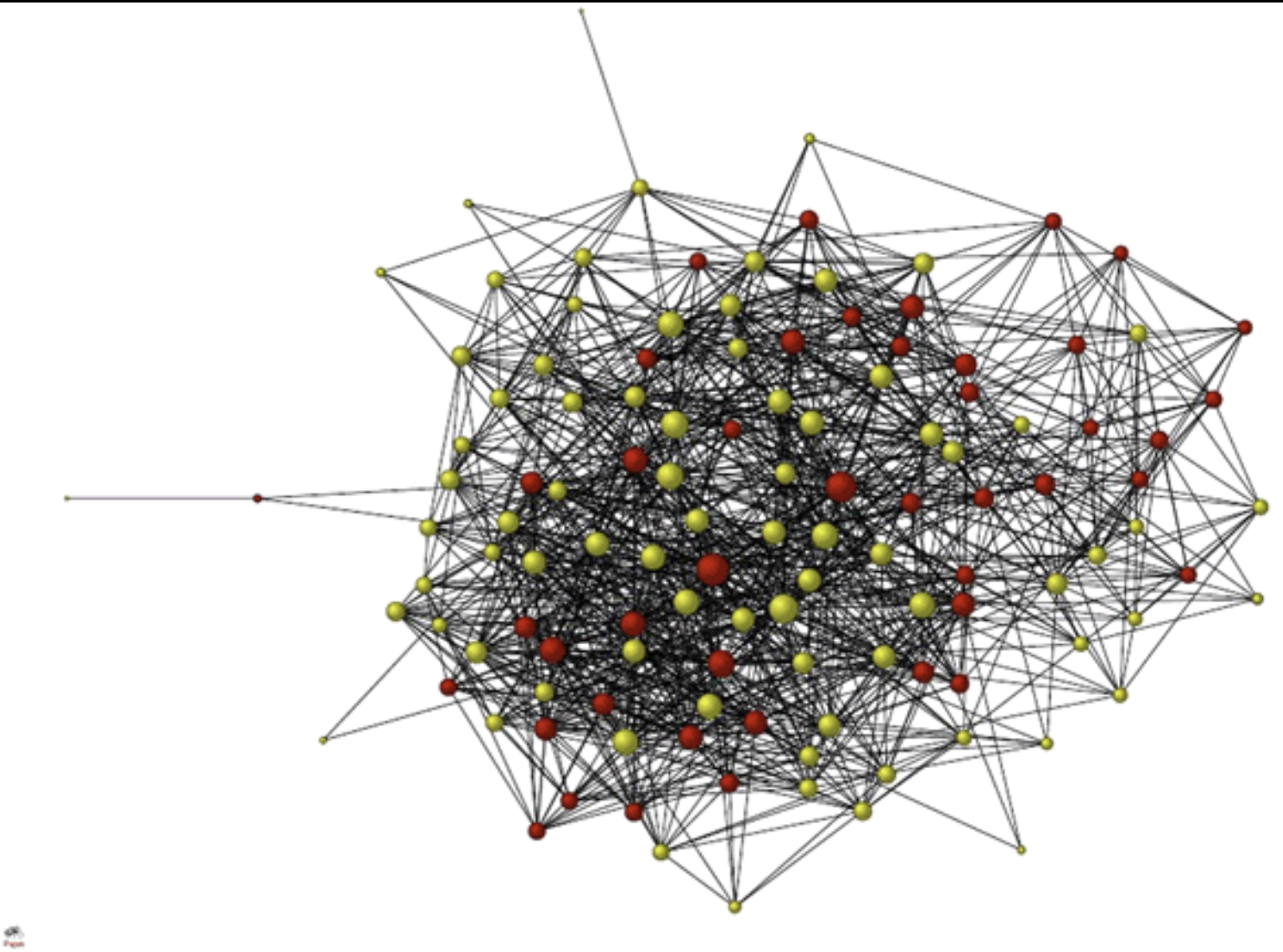
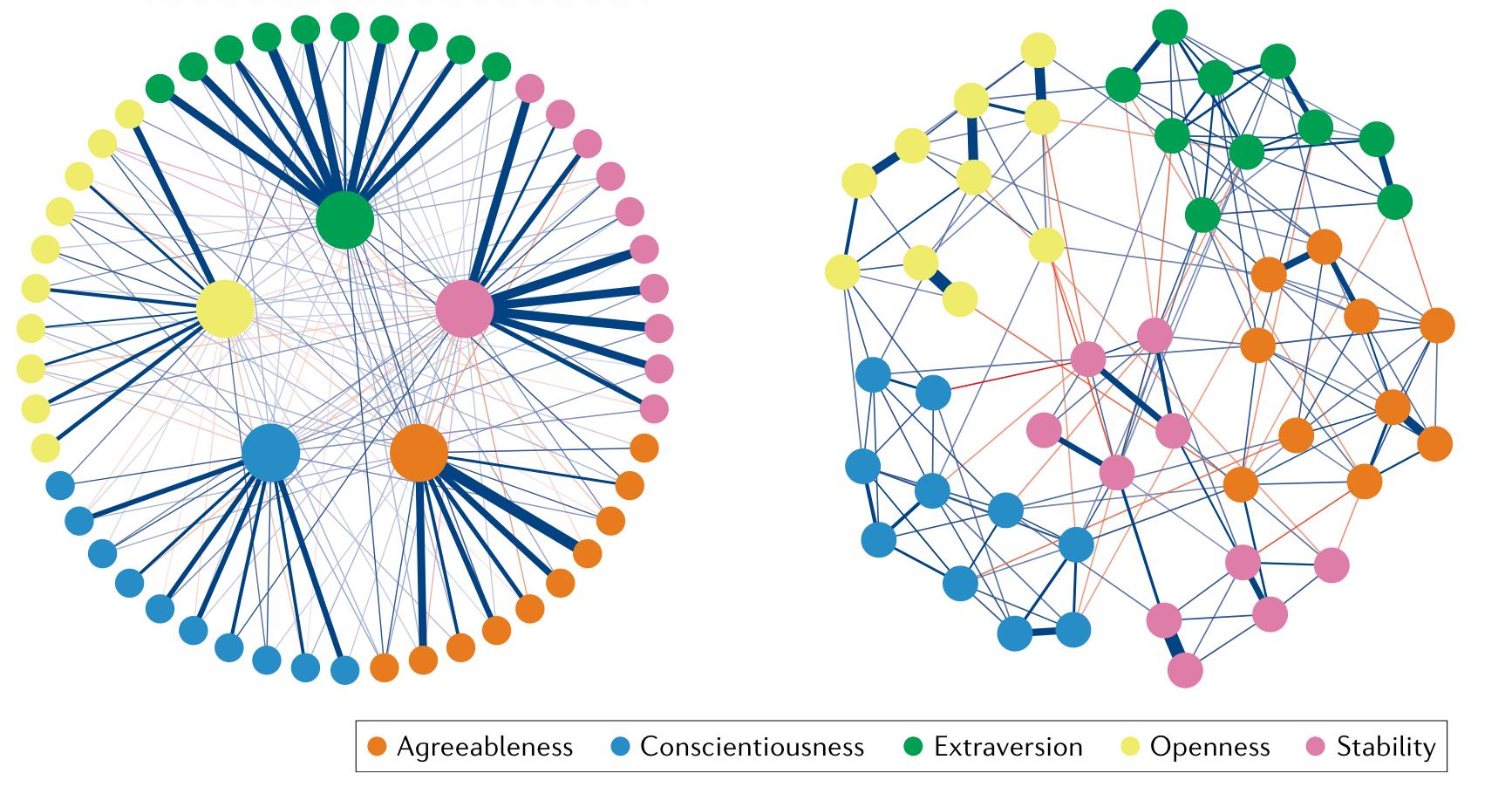
1 and 2 focus on the probabilistic relationships and further casual relationships among variables. 3 and 4 focuses on network structure and node importance. 5 focus on the regression coefficients of structural and measurement mdoel.
All 5 analysis methods have a network-shaped diagram. Graphical modeling is a more “general” term that can comprise of the other network models.
Examples of varied networks
Figure 1: Bayesian Network (Briganti et al., 2023)
Figure 2: Facebook friendship network in a single undergraduate dorm (Lewis et al., 2008)
Figure 3: Factor Analysis and Psychological Network (Borsboom et al., 2021)
Research Aims
Bayesian Network (BN) aims to derive the casual relations between variables
Social Network aims to examine the network structure (community, density or centrality) of individuals
Factor Analysis aims to identify latent variables
Psychological Network aims to examines the associations among observed variables (topological structures) and their positions in the network.
Network Psychometrics
Network psychometrics is a novel area that allows representing complex phenomena of measured constructs in terms of a set of elements that interact with each other.
It is inspired by the so-called mutualism model and research in ecosystem modeling (Kan et al. 2019).
A mutualism model proposes that basic cognitive abilities directly and positively interact during development.
Psychometric network arises as dynamics or reciprocal causation among variables are getting more attentions.
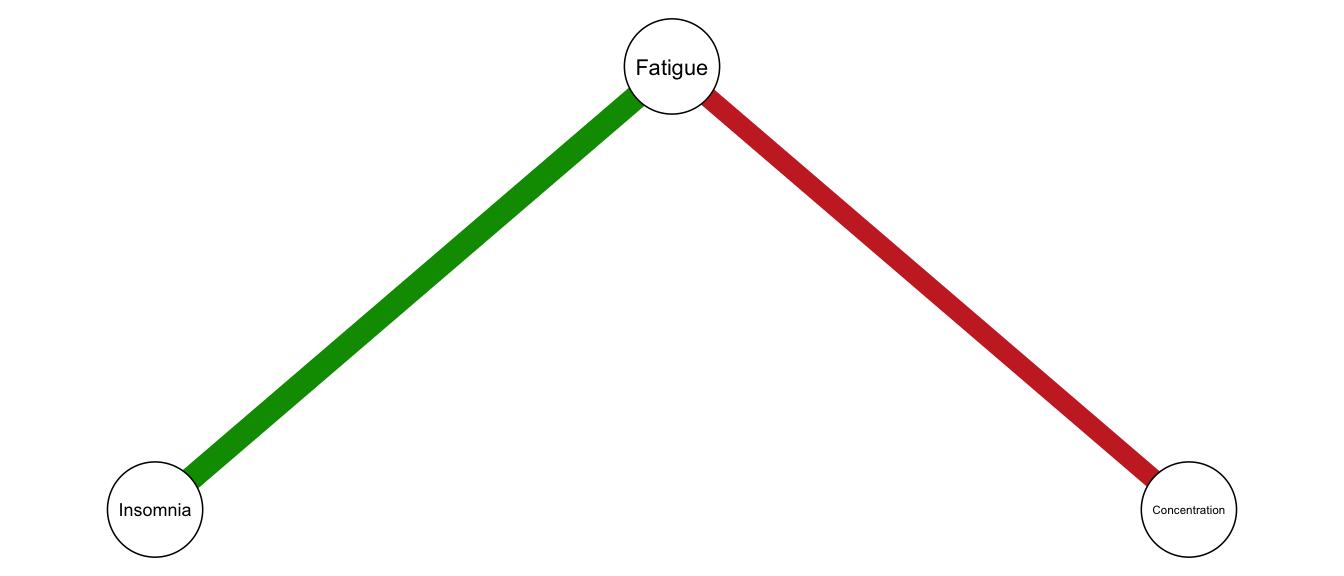
For example, individual differences in depression could arise from, and could be maintained by, vicious cycles of mutual relationships among symptoms.
A depression symptom such as insomnia can cause another symptom, such as fatigue, which in turn can determine concentration problems and worrying, which can result in more insomnia and so on.
Comparison to factor analysis
Factor analysis (common factor model) assumes the associations between observed features can be explained by one or more common factors.
For example, higher “depression” level leads to increased frequency of depressive behaviors
Psychometric network, however, assumes the associations between observed features ARE the reason of the development of depression. Or “depression” is the network itself.
unavoidable cycle of “fatigue -> worrying -> insomnia -> fatigue” will leads to higher “depression”
Utility of Psychometric Network
Explain the pathways of certain psychological phenomenon
Identify the most important problem that needed to be intervene in the treatment procedure
Examine group differences in interactions among observed features
Examine density of network: more dense network indicates more dynamic of certain problems
Examine clusters/communities of observed features: some symptoms are more likely to concur than other symptoms
Terminology I - Overall procedure
Network structure estimation: the application of statistical models to assess the structure of pairwise (conditional) associations in multivariate data.
Network description: characterization of the global topology and the position of individual nodes in that topology.
Psychometric network analysis: the analysis of multivariate psychometric data using network structure estimation and network description.
Terminology II - Network description
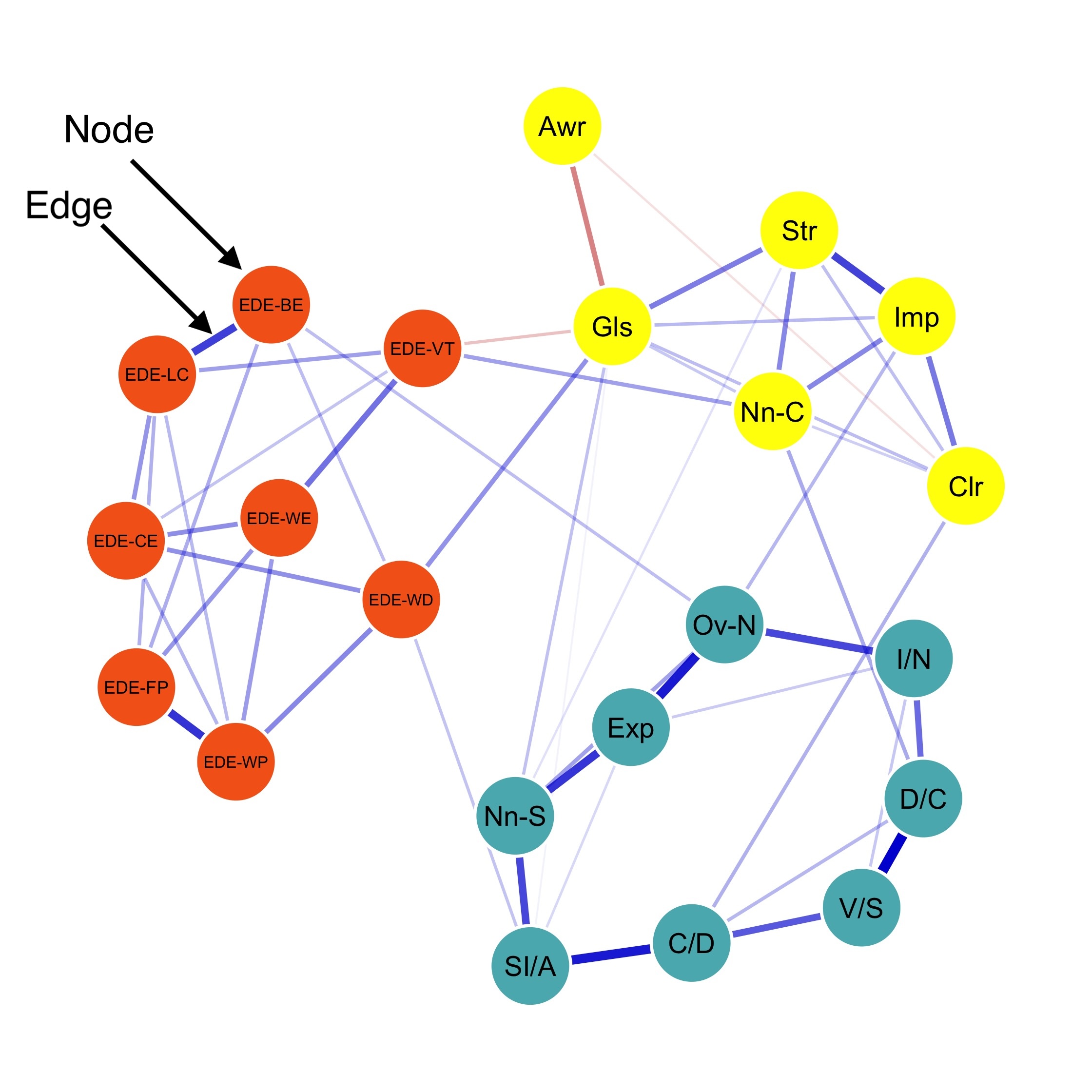
Node: psychometric variables that are selected in the network
such as responses to questionnaire items, symptom ratings, and cognitive test scores, background variables such as age and gender, experimental interventions.
Edge (conditional association): associations between variables taking into account other variables that may explain the association
Edge weight: parameter estimates that represent the strength of conditional association between nodes
Node centrality: the relative importance of a node in the context of other nodes, that can be calculated using different statistics
Terminology III - Network structure estimation
Node selection: the choice of which variables will function as nodes in the network model.
Network stability analysis: the assessment of estimation precision and robustness to sampling error of psychometric networks.
Pairwise Markov random field (PMRF): an undirected network that represents variables as nodes and conditional associations as edges, in which unconnected nodes are conditionally independent.
Exploratory Nature
Pyschometric network is exploratory by nature. To obtain a meaningful network structure, psychometric networks need to drop weak edges but keep strong edges.
This procedure is typically called edge selection. One popular edge selection method is regularization.
Original network structure without regularization is called saturated network; vice versa regularized network
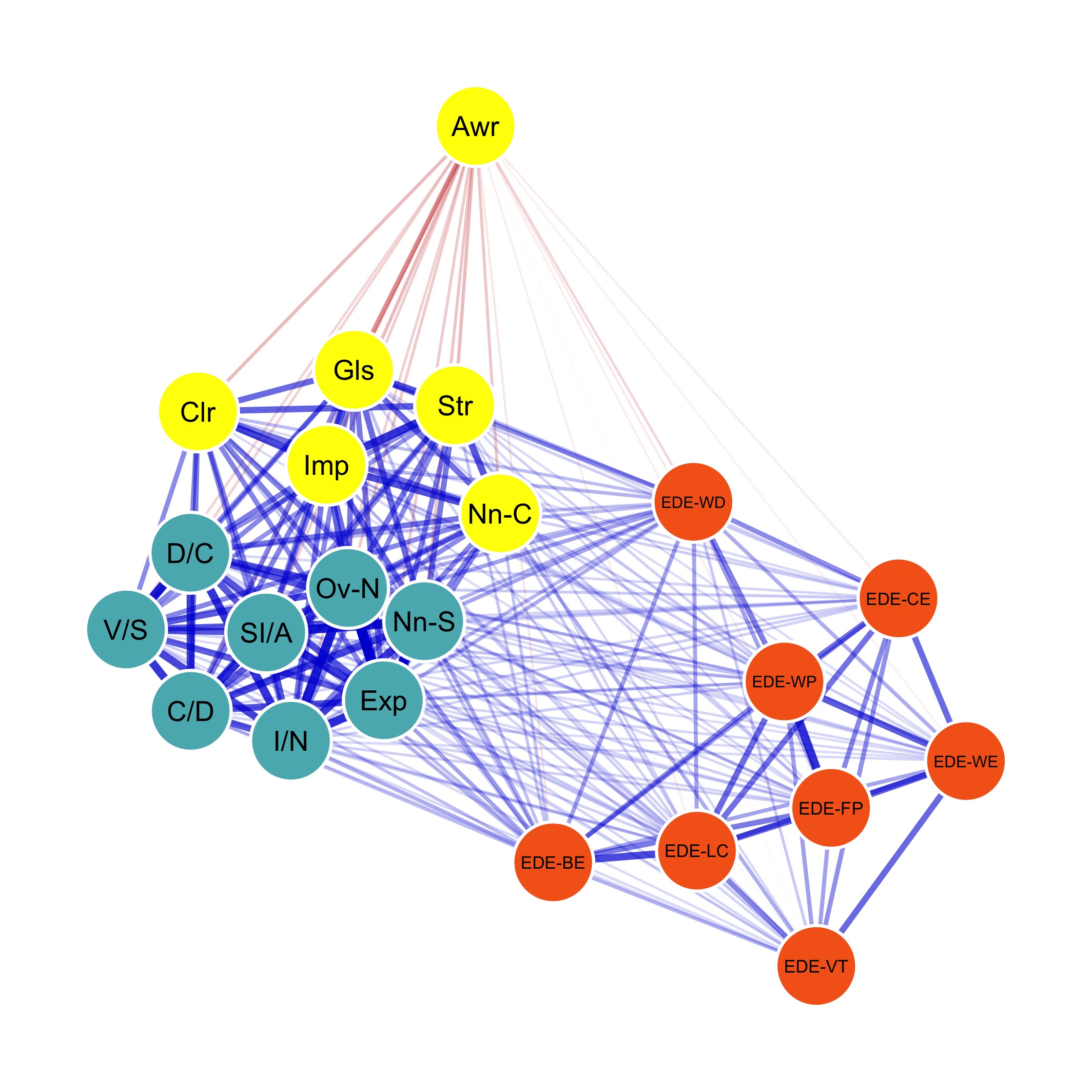
Emotion regulation (Awareness), Interpersonal problems and eating disorder
Workflow of psychometric network
Psychometric network analysis methodology includes steps of network structure estimation (to construct the network), network description (to characterize the network) and network stability analysis (to assess the robustness of results).
Types of data and network models
Cross-sectional data (N = large, T = 1)
Ising model for categorical variables
Gaussian graphical model (GGM; Foygel & Drton, 2010) for continuous variables
Mixed graphical model (MGM) for mixed types of variables
Panel data (N >> T)
Multilevel graphical vector autoregression
i.e., longitudinal data, repeated measures
Time-series data (\(N \geq 1\), T = large)
Graphical vector autoregression
i.e., ecological momentary assessment, conducted via smartphones
Network Estimation
Gaussian graphical model
GGM is one type of Pairwise Markov random field (PMRF) when data are continuous.
In a PMRF, the joint likelihood of multivariate data is modelled through the use of pairwise conditional associations, leading to a network representation that is undirected.
For \(p\)-dimensional data following multivariate normal distribution:
Where \(K\) is a inverse covariance matrix of \(\bb{X}\) (\(K = \Sigma^{-1}\)), also known as precision/concentration matrix.
To obtain sparse network structure, the \(i\)th row and \(j\)th column element of \(\bb{K}\), \(k_{ij}=0\) when edge \(\{j, k\}\) is not included in the network \(G\),
It means \(X^{(i)}\) and \(X^{(j)}\) are independent conditional on the other variables .
Partial correlation networks
GGM can be standardized as the partial correlation network, in which each edge of GGM representing partial correlations between two nodes.
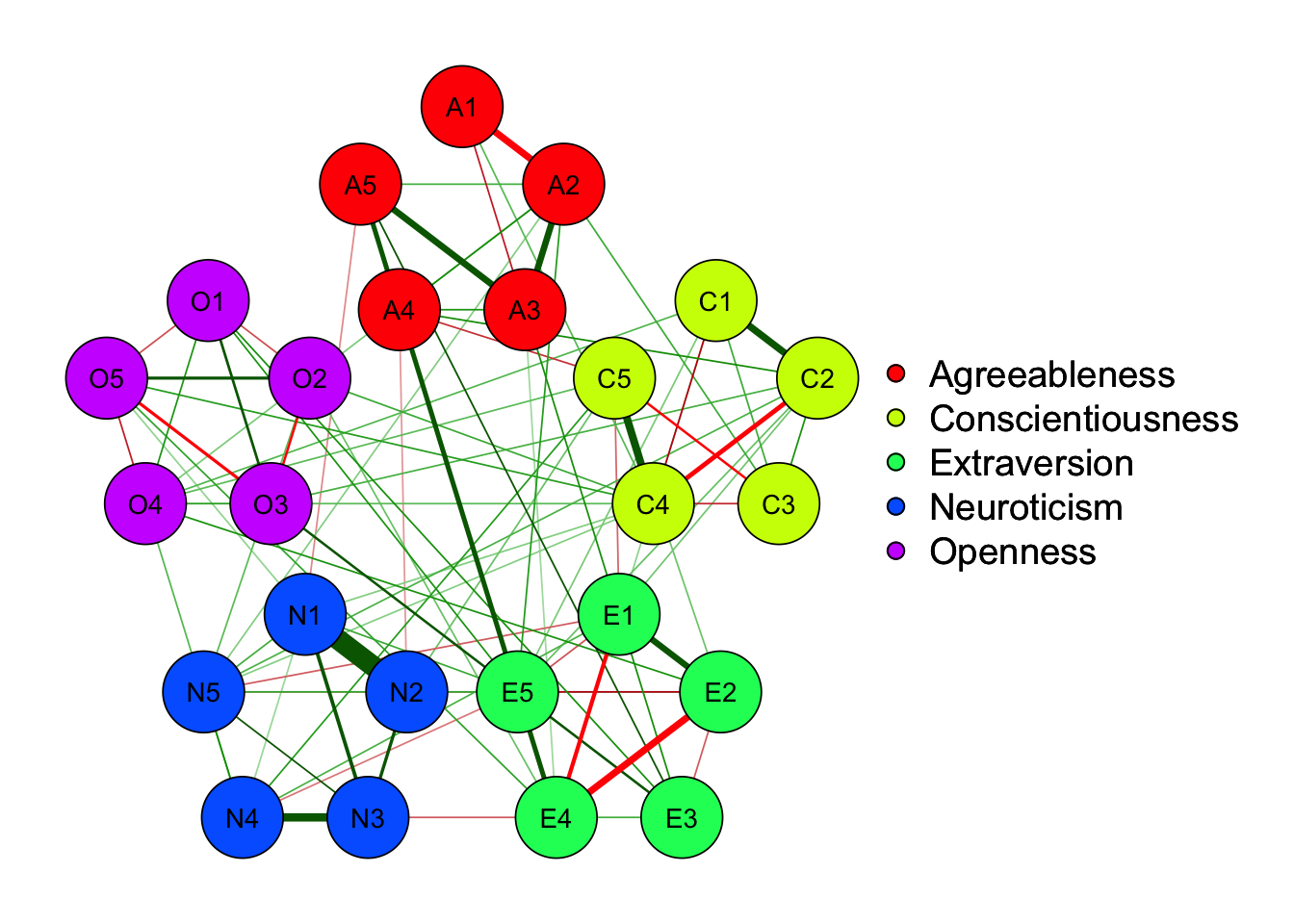
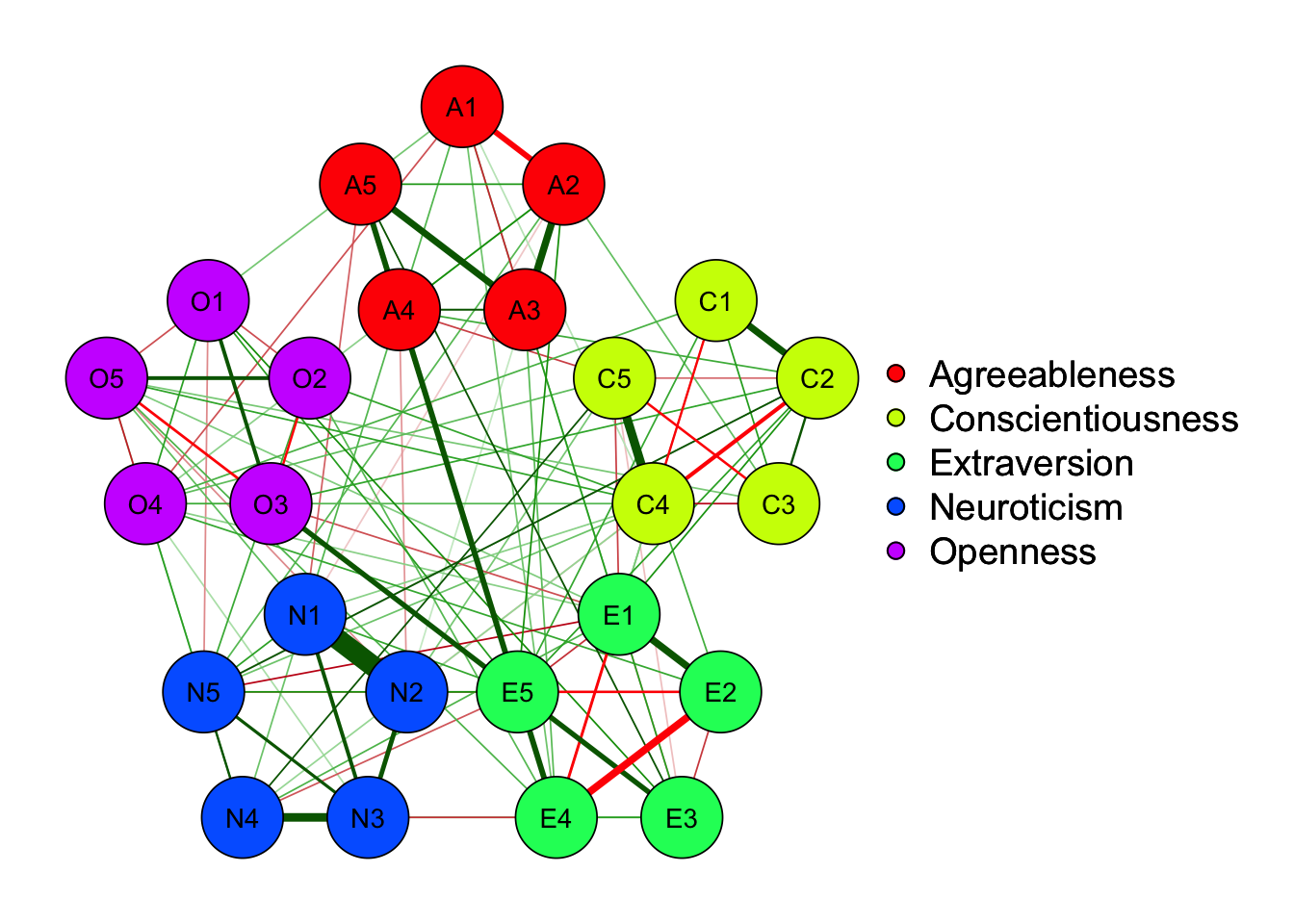
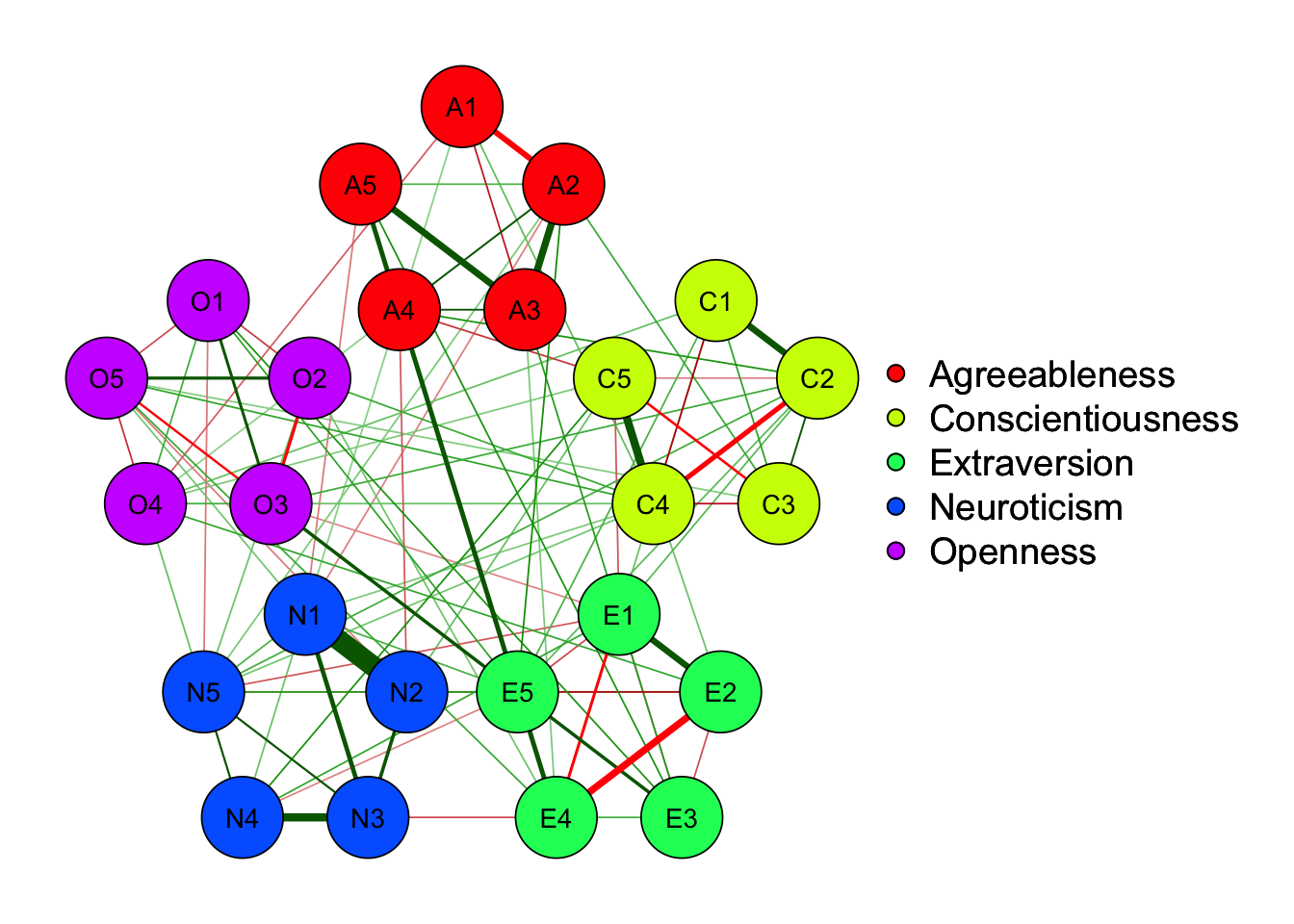
70.6% edges are nonzero using EBICglasso, while only 63.6% edges are nonzero using BF method and 62.0% edges are kept using \(\alpha =.01\) significance testing
EBICglasso
library(psych)
Attaching package: 'psych'
The following object is masked from 'package:BGGM':

    bfi
The following object is masked from 'package:psychonetrics':

    bifactor
BGGMfit <- BGGM::explore(bfi[,1:25], type ="continuous", iter =1000, analytic =FALSE) |>select()
BGGM: Posterior Sampling
BGGM: Prior Sampling
BGGM: Finished
Bayes Factor
density_nonzero_edge(BGGMfit$pcor_mat_zero)
[1] 0.6666667
Network Structure
EBICglasso
Sig. Test
BF
Centrality - Strength
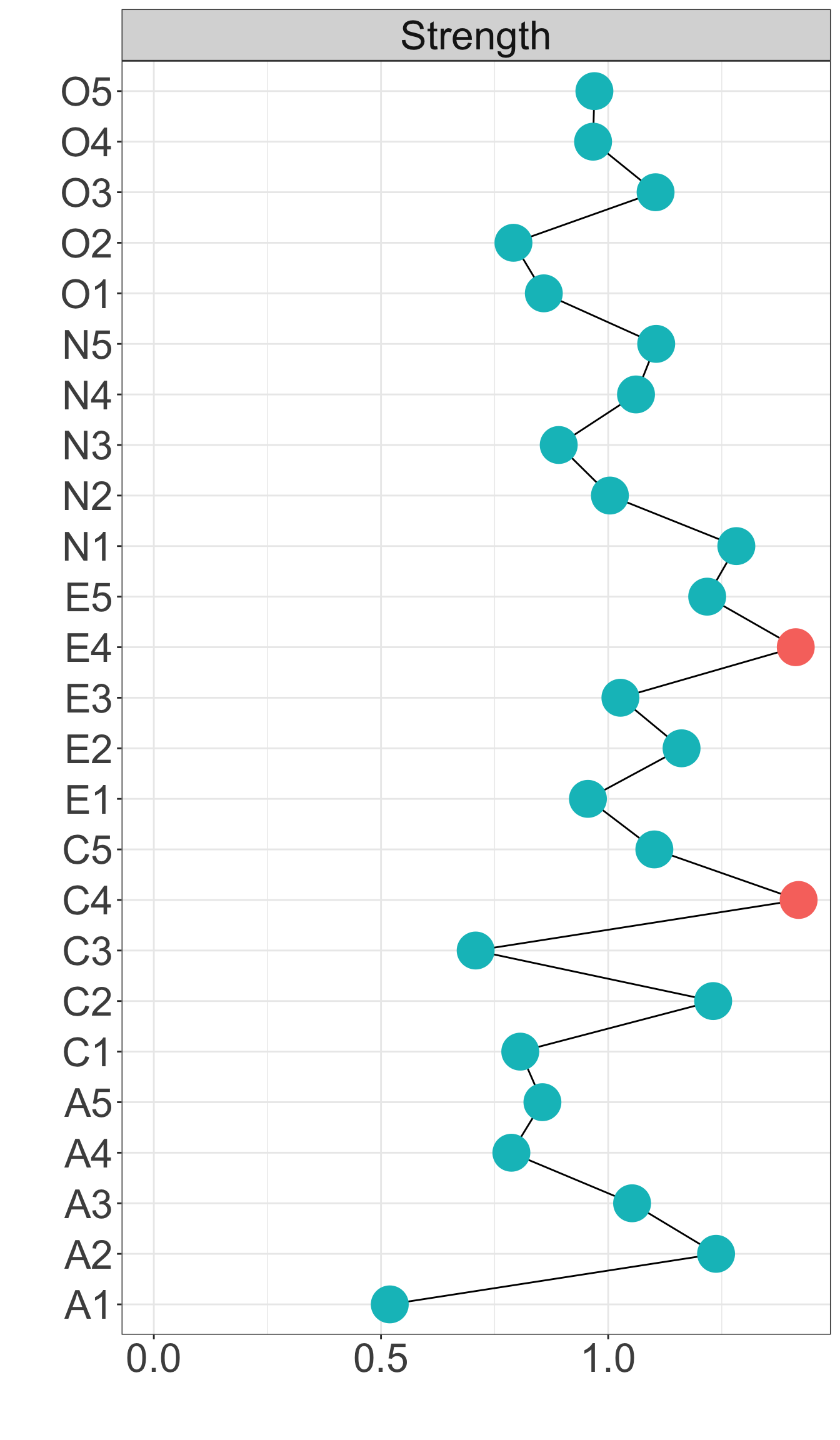
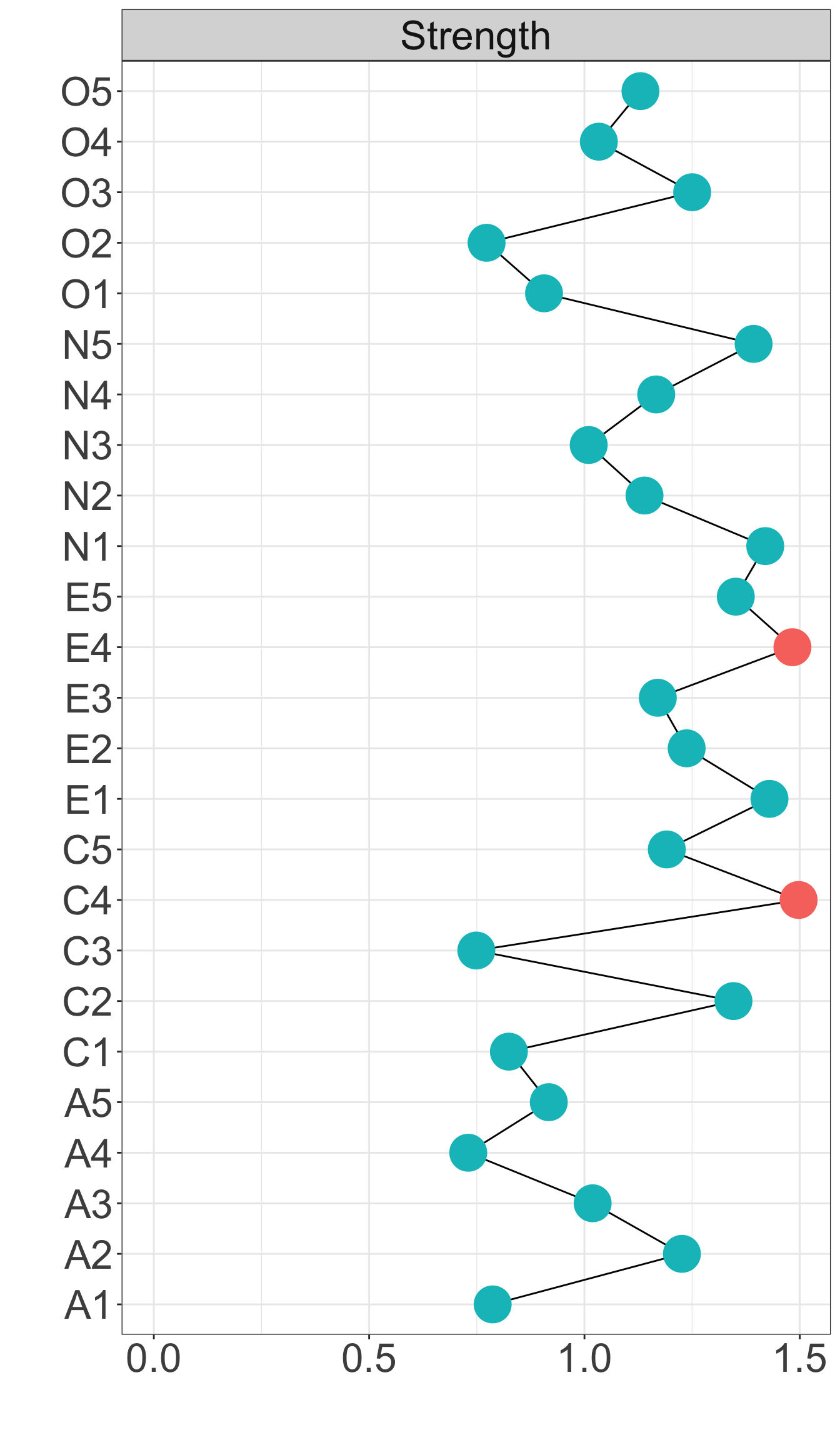
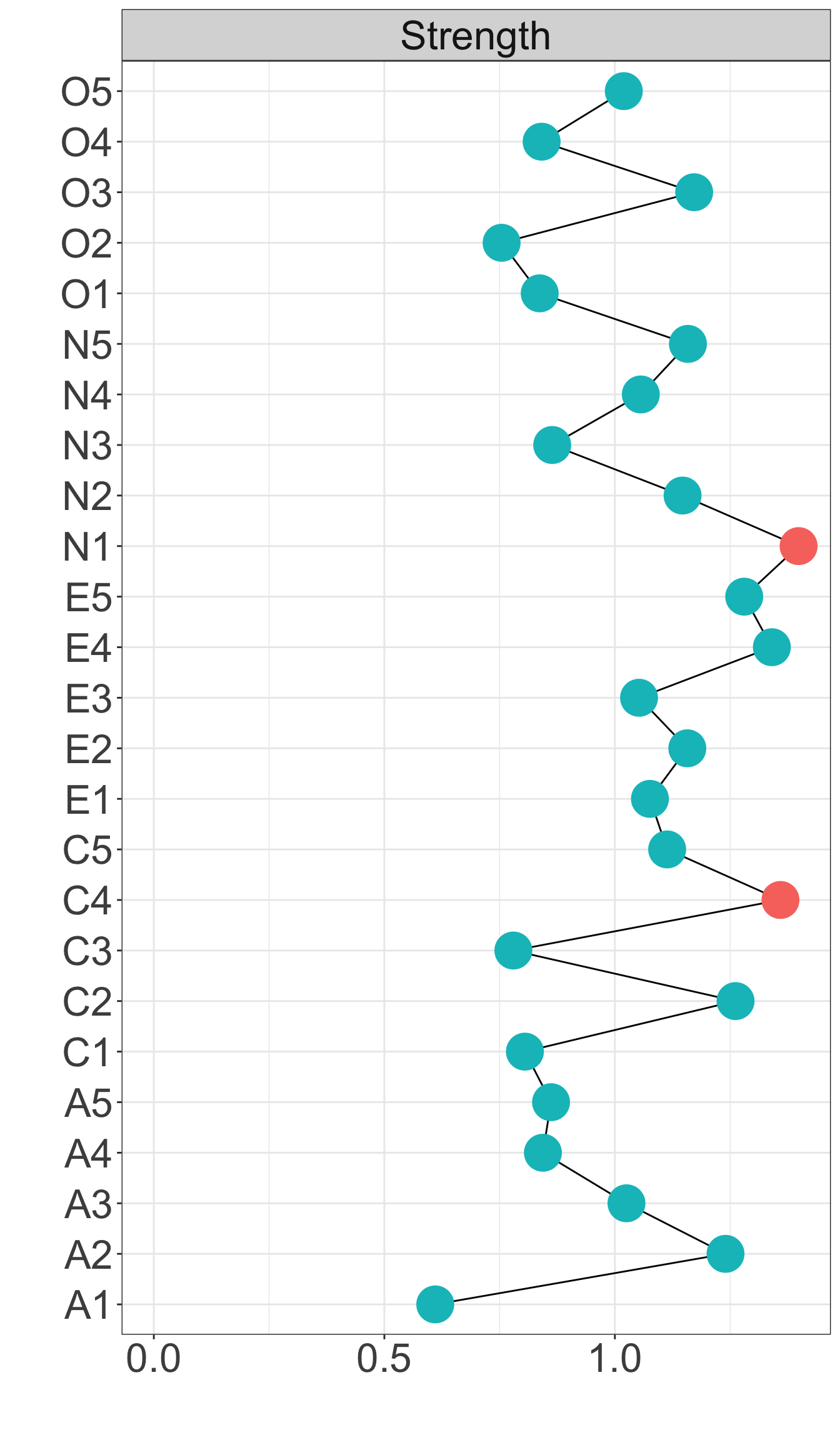
Strength centrality measures suggest that C4 and E4 or N1 have highest centrality indicating they play most imporatant roles in the networks.
Attaching package: 'ggplot2'
The following objects are masked from 'package:psych':

    %+%, alpha
Method 1: EBICglasso
Method 2: Sig. Test
Method 3: Bayes Factor
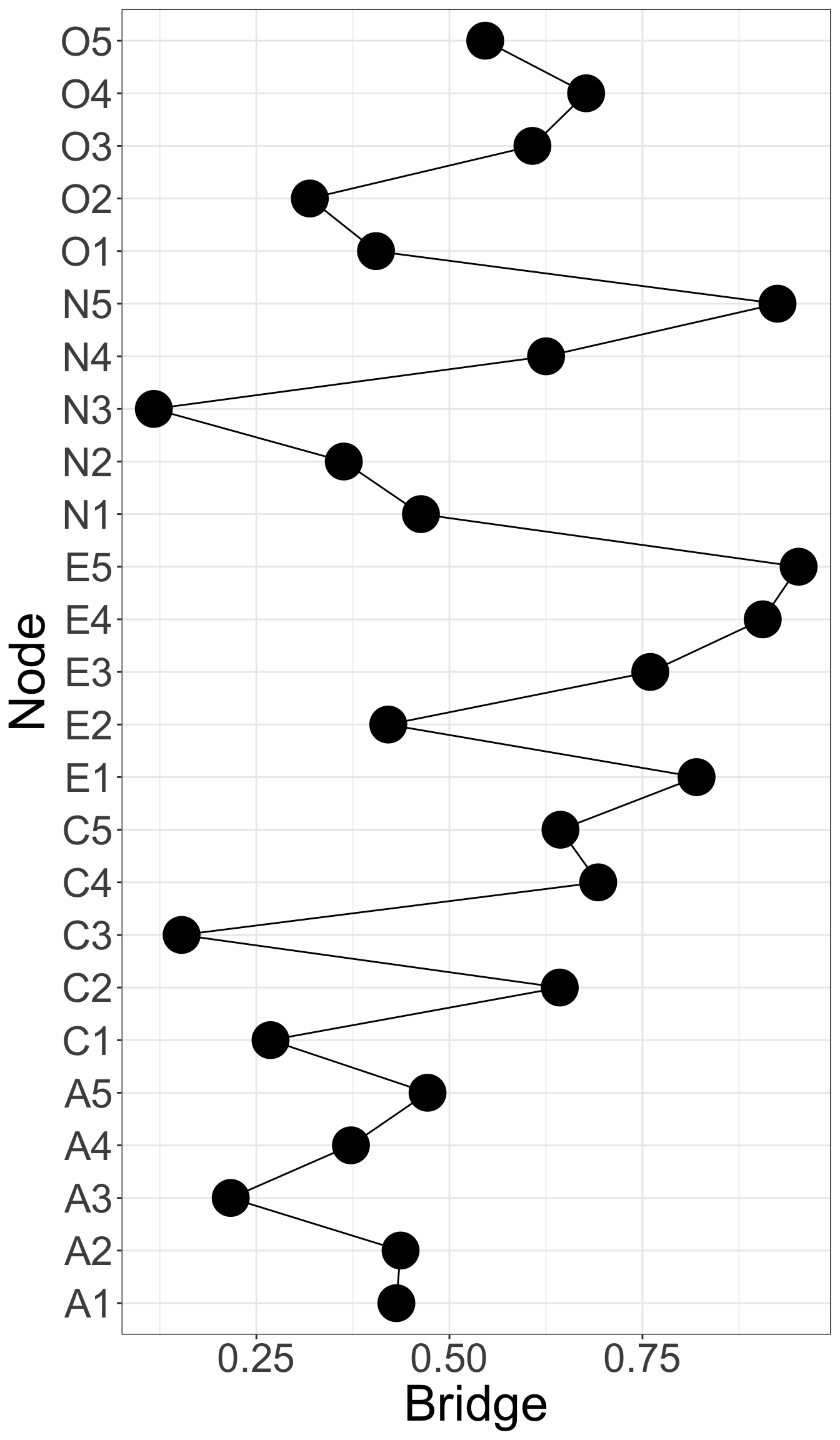
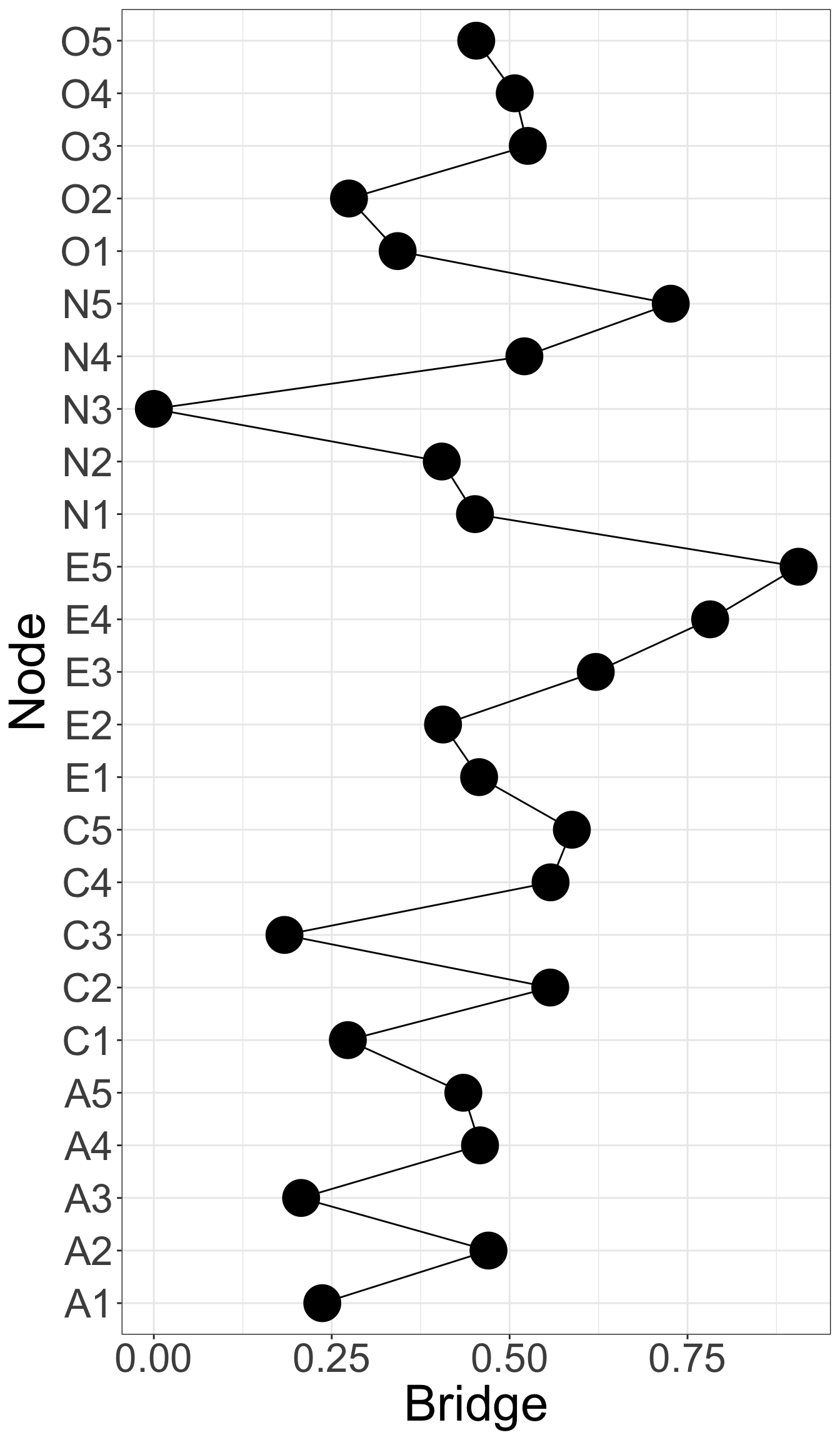
Centrality - Bridge
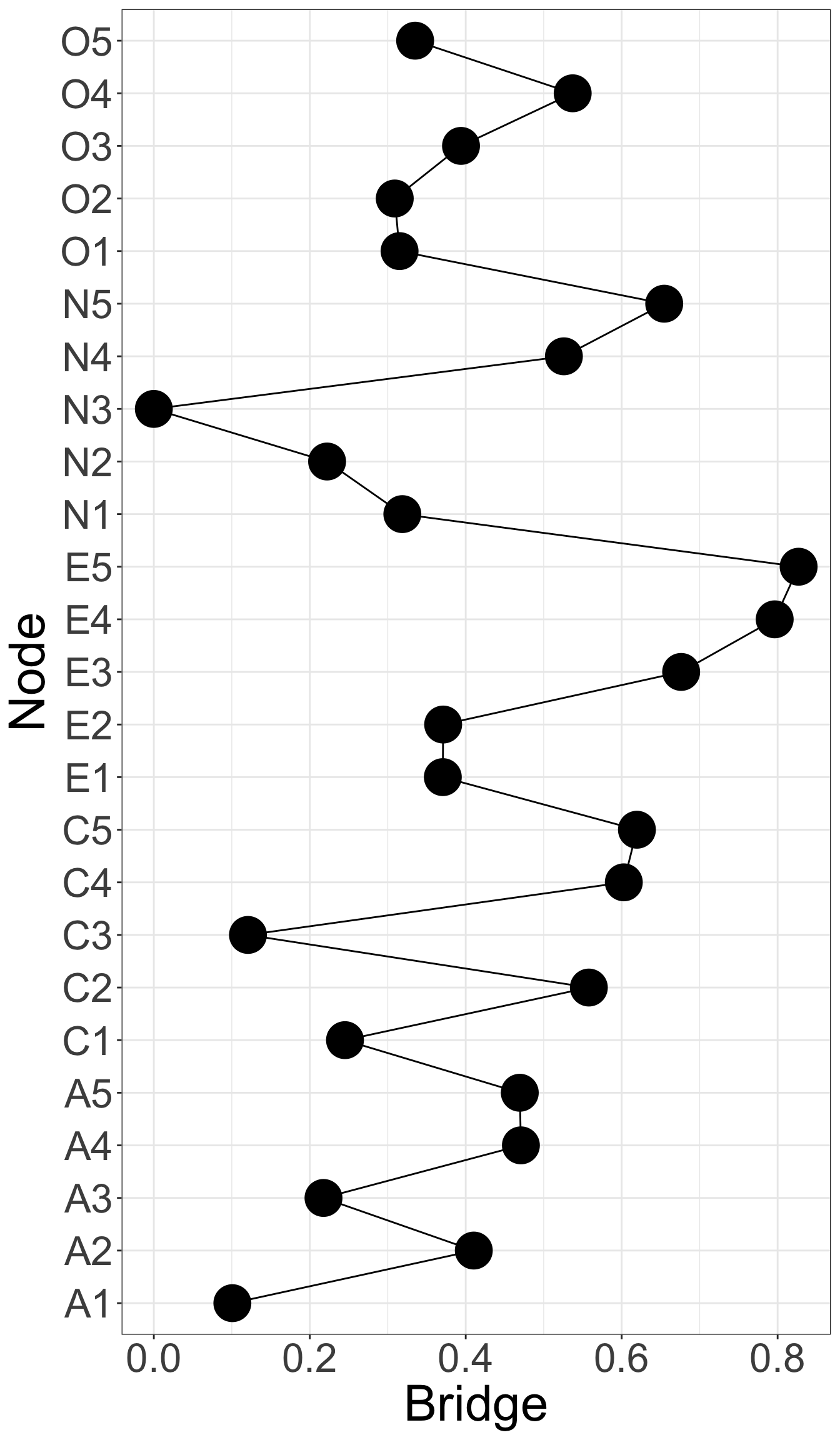
E4 and E5 has highest bridge strength, indicating they serve as bridges linking communities of personality. They are important elements connecting varied types of personality
── Attaching core tidyverse packages ──────────────────────── tidyverse 2.0.0 ──
✔ dplyr     1.1.4     ✔ readr     2.1.5
✔ forcats   1.0.0     ✔ stringr   1.5.1
✔ lubridate 1.9.4     ✔ tibble    3.2.1
✔ purrr     1.0.4     ✔ tidyr     1.3.1
── Conflicts ────────────────────────────────────────── tidyverse_conflicts() ──
✖ ggplot2::%+%()   masks psych::%+%()
✖ ggplot2::alpha() masks psych::alpha()
✖ dplyr::filter()  masks stats::filter()
✖ dplyr::lag()     masks stats::lag()
✖ purrr::map()     masks BGGM::map()
✖ dplyr::select()  masks BGGM::select()
ℹ Use the conflicted package (<http://conflicted.r-lib.org/>) to force all conflicts to become errors
Registered S3 methods overwritten by 'networktools':
  method         from
  print.bridge   bridgesampling
  summary.bridge bridgesampling
Method 1: EBICglasso
Method 2: Sig. Test
Method 3: Bayes Factor
Wrapping up
Network analysis is an alternative way of modeling dependency among variables.
Gaussian graphical model is used for multivariate continuous data.
The goal is to estimate network structure, node importance, and stability.
Kan, Kees-Jan, Han L. J. van der Maas, and Stephen Z. Levine. 2019. “Extending Psychometric Network Analysis: Empirical Evidence Against g in Favor of Mutualism?”Intelligence 73 (March): 52–62. https://doi.org/10.1016/j.intell.2018.12.004.